
UM Study Reveals How the Brain Recovers from Post-Viral Smell Loss
A research team from the University of Macau (UM) has uncovered new neurobiological underlying post-viral olfactory dysfunction (PVOD) mechanisms, providing promising imaging biomarkers for diagnosing and predicting smell recovery. The study was led by Prof. Zhen Yuan, Head of the Center for Cognitive and Brain Sciences and Professor in the Faculty of Health Sciences (FHS), in collaboration with Dr. Guolin Ma from the China-Japan Friendship Hospital, has been accepted for publication in the international journal CNS Neuroscience & Therapeutics.
PVOD, which became increasingly common after COVID-19, often shows unpredictable recovery patterns. To address this challenge, the research team conducted a multimodal MRI study involving nearly 150 participants, including PVOD, post-traumatic olfactory dysfunction (PTOD), and healthy controls. Their approach integrated functional MRI, quantitative susceptibility mapping (QSM), and brain transcriptomic data to reveal the biological processes contributing to smell loss.
The team discovered that PVOD patients showed significantly enhanced coupling between brain activity and cerebrospinal fluid flow, indicating stronger glymphatic function—the brain’s natural waste-clearance system. Importantly, PVOD patients who fully recovered exhibited the strongest glymphatic activity, suggesting that improved clearance of inflammatory substances may support neural restoration after viral infection.
In addition, QSM results revealed abnormal iron accumulation in regions of the right frontal and temporal cortex that are involved in odor memory and recognition. Excess iron is known to trigger oxidative stress and neuronal damage, making it a potential biomarker for viral-induced olfactory impairment.
By linking QSM findings with whole-brain gene-expression maps, the researchers further identified genes related to axon development, synapse organization, and intracellular signaling, highlighting the brain’s compensatory plasticity during recovery.
This study that glymphatic activity and iron-related MRI markers can provide valuable insight into both the severity and recovery potential of olfactory disorders. The findings offer new scientific evidence for understanding post-viral smell loss and may help guide future diagnostic and treatment strategies.
The corresponding authors are Prof. Zhen Yuan and Dr. Guolin Ma. The first authors are Chantat Leong and Jixin Luan. The project was supported by the University of Macau, the Macao Science and Technology Development Fund, and the National Natural Science Foundation of China.
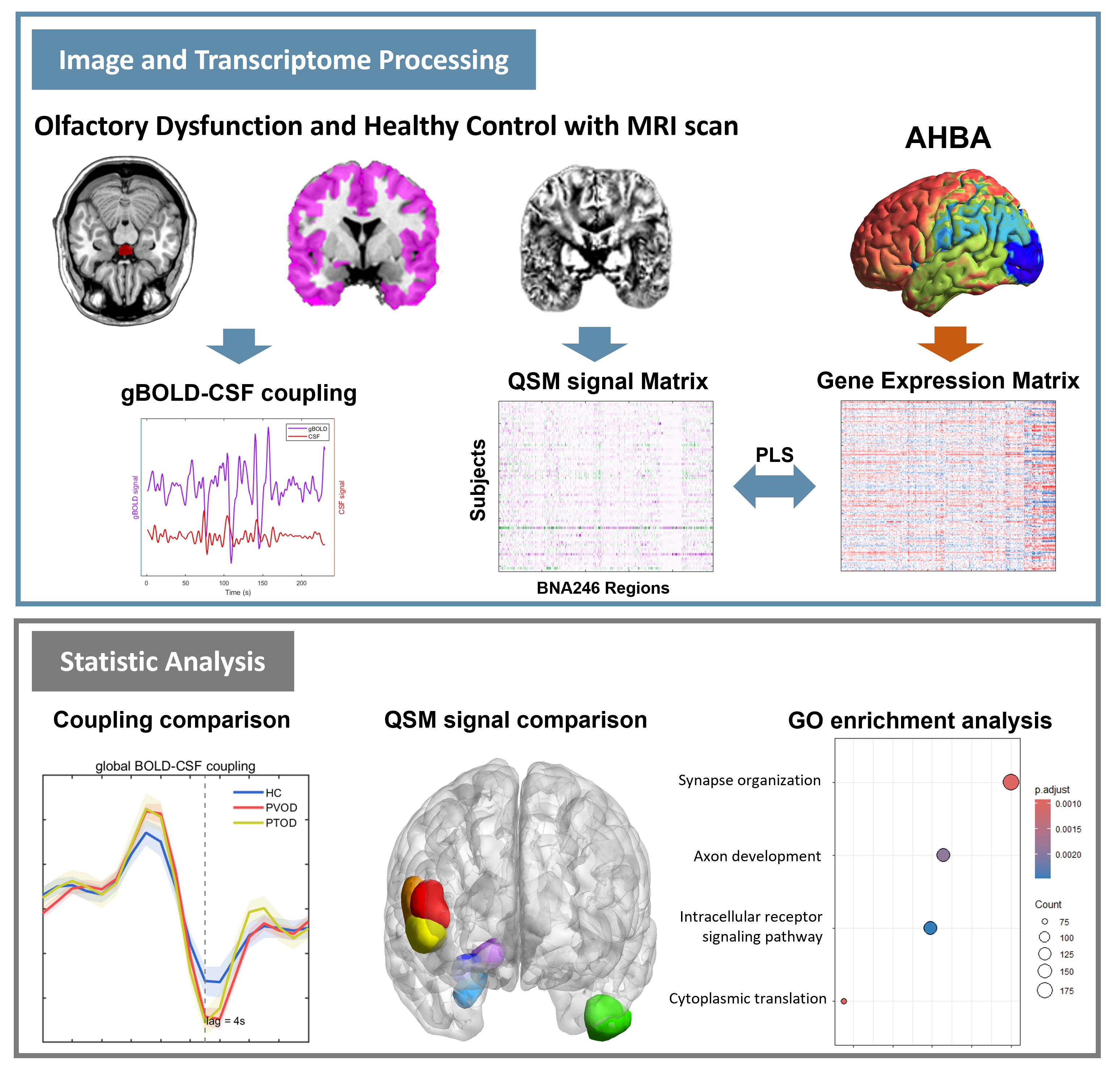
Figure. Multimodal imaging and transcriptomic framework for assessing neurotoxin-related mechanisms in olfactory dysfunction (OD).
This study integrates MRI-based glymphatic function (gBOLD–CSF coupling), quantitative susceptibility mapping (QSM)–derived iron accumulation, and regional gene-expression data from the Allen Human Brain Atlas (AHBA). Group comparisons reveal altered BOLD–CSF coupling, region-specific increases in iron deposition, and enriched biological pathways—including synapse organization, axon development, intracellular receptor signaling, and cytoplasmic translation—associated with OD-related neurotoxic processes. Together, these multimodal findings provide convergent evidence linking neurotoxin accumulation, impaired neural circuitry, and compensatory plasticity in OD.